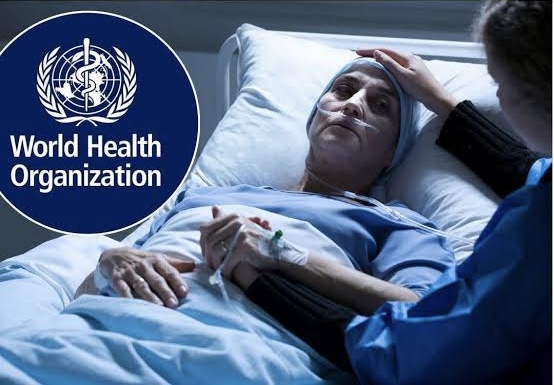
“Cancer is not just a medical diagnosis – it profoundly, indefinitely affects every aspect of a person’s life, and their family’s as well…”Clarissa Schilstra, a childhood cancer survivor and a lead of WHO’s survey.
One in five of us will develop cancer, and nearly all of us will be affected by cancer at least once in our lifetime.
However, our experience of the disease and chances of surviving now depend less on the stage or biology of our disease than on where we live and our economic circumstances.
Cancer remains the second leading cause of death globally, after cardiovascular disease.In 2024, an estimated 20.6 million people worldwide received a cancer diagnosis. Nearly 10 million died from the disease which is more than 26,000 lives lost every single day. Cancer is increasingly a driver of premature mortality, and in 2021, was the leading cause of premature mortality in 41 countries, the second leading cause in 37 countries, and third leading cause in 47 countries.
These numbers come from the World Health Organization’s Global Status Report on Cancer 2026: The Future We Choose Together, released in July 2026 and developed jointly with the International Agency for Research on Cancer (IARC). The report offers the most comprehensive picture yet of the global cancer burden, the capacity of health systems to respond, and the lived experiences of people affected by the disease.
It reveals two stories unfolding in parallel: remarkable scientific progress on one side, and persistent, often widening inequities on the other.
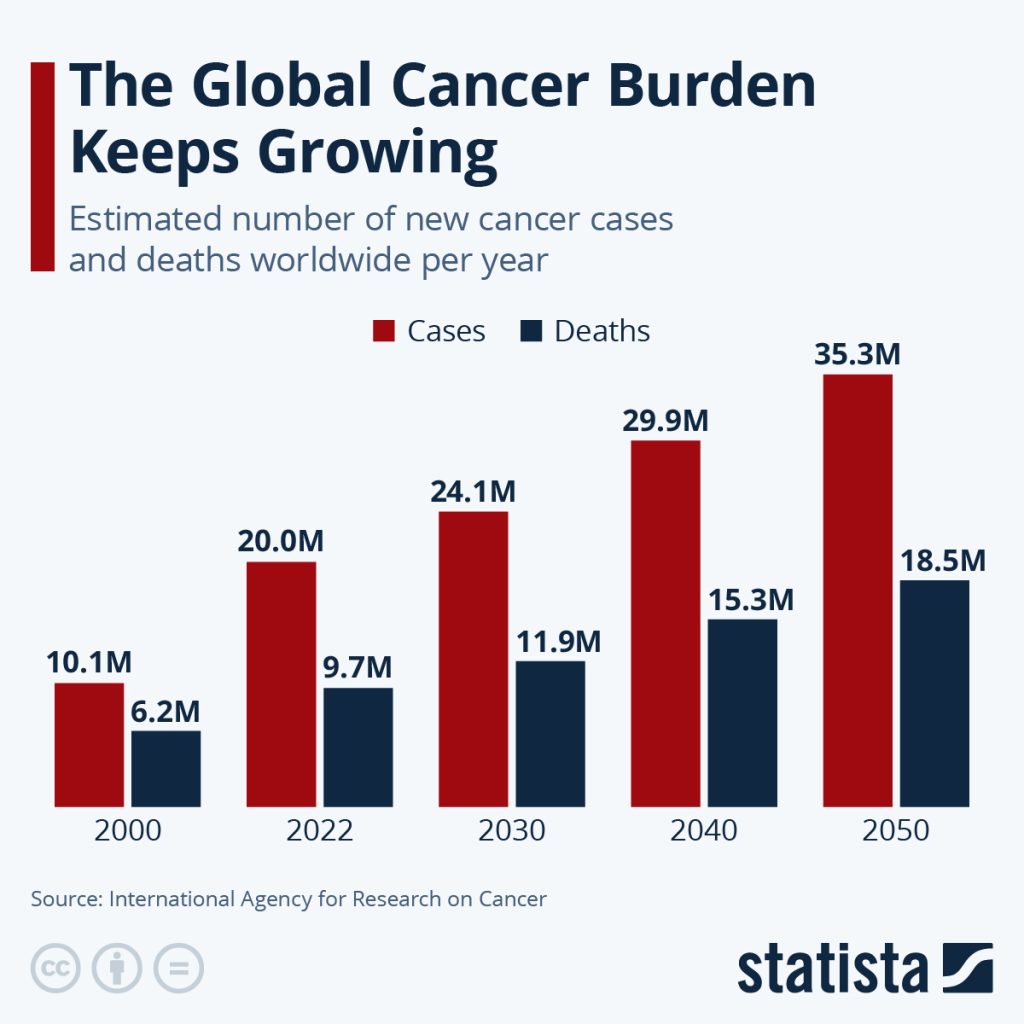
Without urgent action, the annual number of new cases is projected to climb to nearly 35 million by 2050. The crisis is getting bigger. The question the report forces us to confront is whether the future will be defined by preventable suffering or by deliberate, equitable choices.
The Scale of the Burden
The latest GLOBOCAN estimates, published in CA: A Cancer Journal for Clinicians in 2026, put the 2024 figures at 20.6 million new cases (19.5 million excluding non-melanoma skin cancer) and 9.8 million deaths. Lifetime risk stands at one in five people developing cancer, one in nine men and one in thirteen women dying from it.
Lung cancer leads in both incidence and mortality: about 2.6 million new cases (12.8 percent of the total) and 1.9 million deaths (19 percent of cancer deaths). Female breast cancer ranks second in incidence with roughly 2.4 million cases, followed by colorectal, prostate, and stomach cancers. For deaths, lung is followed by colorectal, liver, breast, and stomach cancers.
Yet although the cancer burden is near-universal in its reach, people’s lived experience of the disease is highly inequitable, with significant variation both between and within countries.
Geography shapes the picture dramatically. Asia accounted for more than half of all cases and deaths in 2024, reflecting its large population. Europe, with only about 9 percent of the world’s people, contributed 21 percent of cases and 20 percent of deaths. Many countries in Africa and parts of Asia still show lower incidence rates but significantly higher mortality, a pattern driven by later diagnosis and limited access to care.
Looking ahead, population growth and ageing alone are expected to push annual incidence to approximately 34.4–35 million cases by 2050—an increase of about 67 percent from 2024 levels, assuming rates remain constant. Cancer is already a leading or rising cause of premature mortality in dozens of countries. Only a small minority are on track to meet the target of reducing premature cancer deaths by one-third by 2030.
The Inequity at the Heart of the Crisis
“Cancer is a deeply personal disease that touches nearly all of us. But whether a person survives cancer should never depend on where they were born or what they earn, The inequities documented in this report are not inevitable; they are the consequence of choices, and they can be reversed through stronger and unified action.”Dr Tedros Adhanom Ghebreyesus, WHO Director-General.
The most striking message of the 2026 report is not simply that the numbers are rising, but that outcomes depend heavily on where a person lives and their economic circumstances. New WHO estimates of five-year breast cancer survival which was published alongside the report in Nature Medicine, make this concrete. The global median five-year net survival for women diagnosed between 2017 and 2021 was 77.8 percent. In high-income countries it reached about 87 percent. In low-income countries it fell to roughly 42 percent. Regional averages ranged from around 39 percent in the African Region to nearly 89 percent in the Region of the Americas.
Stage at diagnosis remains a powerful driver of these gaps. In high-income settings, the majority of breast cancers are found at early stages. In many low- and middle-income countries, advanced disease is far more common. Access to diagnostics, surgery, radiotherapy, essential medicines, and trained specialists is uneven. Only about 28 percent of countries include a basic package of cancer services in their universal health coverage benefit packages. Availability of priority cancer medicines is markedly lower in low- and lower-middle-income countries than in high-income ones. Some low-income countries have no radiotherapy facilities at all.
The human cost is profound. A WHO global survey of people affected by cancer found that more than half reported mental-health impacts, at least 45 percent experienced financial hardship, and nearly all caregivers described significant strain. Cancer is a leading driver of catastrophic health expenditure and medical bankruptcy for households. Even in countries with formal universal coverage, indirect costs such as lost income, transport, and childcare can be devastating. Between 2020 and 2050, the broader economic burden of cancer is estimated to be equivalent to an annual tax of roughly 0.55 percent on global GDP.
Progress and the Gap Between Plans and Outcomes
The report does not paint a picture of unrelieved failure. Measurable advances have occurred. Global tobacco use has declined by about 27 percent since 2010, linked to implementation of the WHO Framework Convention on Tobacco Control and the MPOWER measures. HPV vaccination programmes now exist in 85 percent of countries, putting cervical cancer on a credible pathway toward elimination in many settings, even though first-dose coverage among girls remains only around 31 percent. Survival has improved for several common cancers in better-resourced health systems. The share of countries with national cancer control plans has risen from 50 percent in 2010 to about 82 percent.
Yet a substantial implementation gap persists. Early-detection programmes that transformed outcomes in high-income countries have not been scaled in most low- and middle-income settings. Screening coverage for cervical cancer is far higher in high-income countries than in low- and middle-income ones, with high loss to follow-up after positive tests. Access to surgery, radiotherapy, systemic therapy, palliative care, and survivorship services remains inadequate for large parts of the world’s population. Workforce shortages are severe, and data systems for monitoring progress are incomplete in many places. Obesity and physical inactivity trends are moving in the wrong direction. Alcohol control policies remain weak in many regions.
Scientific advances and new treatments continue to emerge, but the benefits are unevenly distributed. The report’s central observation is that progress and inequity are happening at the same time.
What Can Be Prevented
A substantial share of the cancer burden is linked to modifiable risk factors. Tobacco, cancer-related infections (including HPV, hepatitis B and C, and Helicobacter pylori), alcohol, excess body weight, physical inactivity, and unhealthy diets account for a large proportion of cases. Estimates suggest that roughly 30–40 percent of cancers are preventable through action on these factors.
The most powerful levers remain primary prevention: sustained tobacco control, expanded vaccination, policies that support healthy weight and physical activity, reduced alcohol consumption, and measures that make healthy diets more accessible. Early diagnosis and organised screening, where infrastructure and follow-up systems exist, further reduce mortality. These interventions deliver benefits across the population and reduce pressure on treatment systems.
Three Strategic Shifts and Seven Recommendations
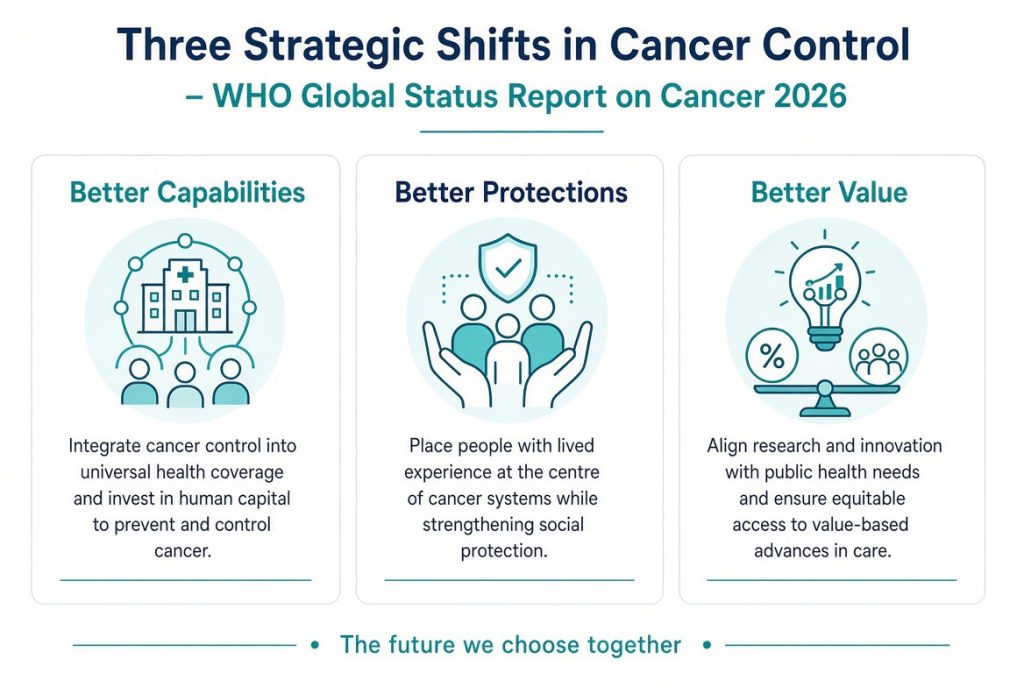
The 2026 report proposes a clear framework for action built around three strategic shifts: better capabilities, better protections, and better value.
Better capabilities means integrating cancer control into universal health coverage and investing in the human capital including doctors, nurses, technicians, community health workers needed to deliver services across the continuum from prevention to palliative care. Better protections places people with lived experience at the centre of decision-making and strengthens social protections so that a cancer diagnosis does not automatically mean financial ruin or social isolation. Better value aligns research and innovation with public-health priorities, especially the needs of low- and middle-income countries, and ensures that advances that offer real benefit reach those who need them.
Seven recommendations flow from these shifts. They call for embedding cancer control within broader health-system strengthening and universal health coverage, using well-financed and monitored national cancer control plans as the vehicle for action; strengthening the capacities required for integrated service delivery; including people with lived experience in all relevant decision-making; enhancing community-level health promotion and social protection; improving the alignment and transparency of global data on burden and system performance; unifying the cancer agenda around equity-based, system-wide solutions; and aligning research and innovation with the service needs of lower-resource settings.
The report emphasises that political commitments matter most when they are translated into funded plans, accessible services, robust monitoring, and genuine engagement with affected communities.
What This Means in Practice
For individuals and families, the findings reinforce the value of known prevention measures: not using tobacco, limiting alcohol, maintaining a healthy weight, staying physically active, and taking up vaccination and screening where they are available and recommended. They also underscore the importance of seeking care early when symptoms arise and of advocating for stronger local and national systems.
For communities and civil society, the report highlights the power of lived experience in shaping better policies and services. For governments and international partners, it is a call to close the gap between plans and delivery by financing national cancer control plans, including essential cancer services in universal health coverage packages, investing in workforce and infrastructure, and ensuring that data systems can track progress.
The future is not fixed. Declines in tobacco use, progress toward cervical cancer elimination, and survival gains in settings that have built stronger systems show what is possible. The 2026 report makes clear that the same level of ambition and investment applied more equitably could change the trajectory for millions of people.
Choosing a Different Future
The cancer crisis is growing in absolute numbers, driven by demographic change. At the same time, a large share of the suffering is preventable, and much of the disparity in outcomes is the result of choices about how health systems are organised and financed. The Global Status Report on Cancer 2026 does not claim that the challenge is easy. It does insist that the tools, the knowledge, and the frameworks for more equitable progress already exist.
Whether the world reaches 35 million new cases a year with the same patterns of inequity, or whether it bends the curve through prevention, earlier detection, and fairer access to care, will depend on the decisions taken in the coming years. The report’s subtitle is deliberate: the future we choose together. The data are now clearer than ever. The choice is ours.
References
1.WHO. Global status report on cancer 2026: the future we choose together. World Health Organization, 8 July 2026. (ISBN 978-92-4-012397-7).
2.Sung H, Filho AM, Laversanne M, Ferlay J, Siegel RL, Soerjomataram I, Jemal A, Bray F. Global cancer statistics 2024: GLOBOCAN estimates of incidence and mortality worldwide for 34 cancers in 186 countries. CA: A Cancer Journal for Clinicians. 2026; e70090. doi:10.3322/caac.70090.
3.Girardi F, Nyangasi M, Callender C, et al. Global breast cancer survival estimates in 2017–2021 to advance the WHO Global Breast Cancer Initiative. Nature Medicine. Published online 8 July 2026. doi:10.1038/s41591-026-04531-2.